
Beyond the Feed-in Tariff: How to Stop “Gifting” Your Solar Power to the Grid in 2026

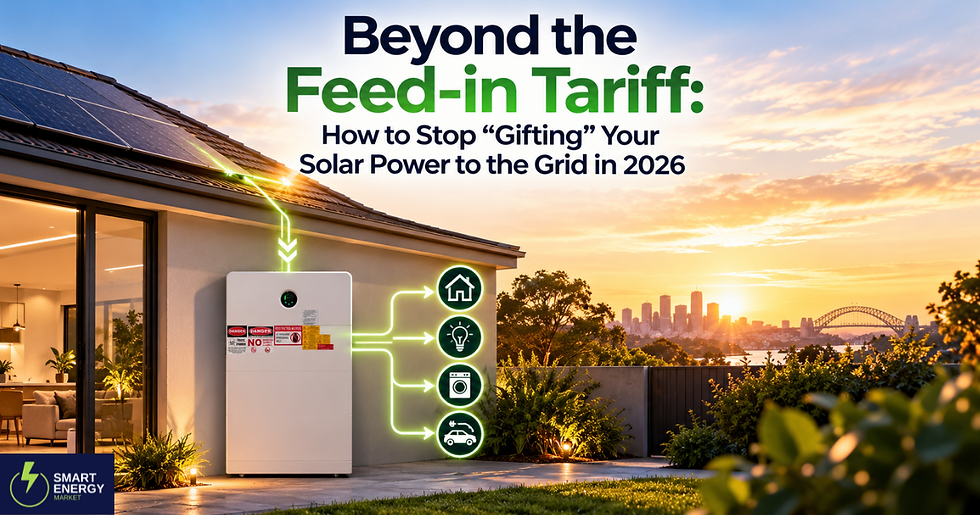
For years, Australian solar households followed a simple strategy: use what you need, export the rest, and receive a feed-in tariff (FiT).
In 2026, that strategy isn't as rewarding as it once was.
Feed-in tariffs have fallen significantly, while the electricity you buy from the grid can cost considerably more than what you receive for exporting solar.
That means the real value of rooftop solar is increasingly found in using more of the electricity you generate yourself.
Instead of asking, “How much solar can I sell?”, homeowners should be asking:
“How much of my solar can I keep and use?”
Why Exporting Solar Is Becoming Less Valuable
Australia now produces huge amounts of rooftop solar during the middle of the day.
When thousands of homes generate electricity simultaneously, the grid can receive more solar than it needs.
The result? Lower daytime electricity values, reduced feed-in tariffs and, under some network tariff structures, export charges during certain periods.
Meanwhile, households still purchase electricity from the grid when their panels stop producing.
For example, exporting 1 kWh for only a few cents may be far less valuable than using that same electricity to avoid purchasing a more expensive kilowatt-hour later.
That's why solar self-consumption has become increasingly important.
1. Shift Your Electricity Use Into the Day
The easiest way to improve self-consumption doesn't require buying anything new.
Simply use more electricity while your panels are producing.
Where practical, schedule energy-intensive appliances during strong solar production, often around late morning to early afternoon.
Hot Water
Set an electric or heat-pump hot water system to operate during daylight hours. Your hot-water tank effectively stores some of your solar energy as heat for later use.
Pool Pumps
Schedule pool pumps and filtration systems to operate while solar generation is high rather than relying on grid electricity later.
Household Appliances
Use delay-start functions on washing machines, dishwashers and other flexible appliances so they operate during your solar-production window.
Small changes like these can increase the amount of solar that directly reduces your electricity purchases.
2. Store Your Excess Solar in a Battery
There is only so much electricity most households can consume during daylight hours.
A home battery provides another option.
Instead of exporting excess solar for a relatively small credit, a battery can store that electricity and make it available later when your panels aren't producing.
For example:
Day: Solar panels generate excess electricity → Battery charges
Evening: Solar production stops → Battery powers the home
This can reduce dependence on expensive evening grid electricity.
Australia's Cheaper Home Batteries Program has also changed the economics of battery storage by providing federal support for eligible systems.
But bigger isn't always better.
The best battery capacity should be matched to your solar generation, evening electricity use, tariff and future needs.
An oversized battery may leave expensive capacity unused, while an undersized system may continue exporting large amounts of valuable solar.
3. Consider a Virtual Power Plant
Battery owners may also have another option: a Virtual Power Plant (VPP).
A VPP connects participating household batteries and allows stored electricity to support the grid when demand is high.
Depending on the provider, participating households may receive financial incentives, credits or other benefits.
A VPP isn't automatically the best choice for everyone. Homeowners should compare the provider's rates, battery-control conditions and incentives before joining.
But for the right household, it can create another way for a battery to generate value.
Smart Energy Management Is the Next Step
Modern solar homes are becoming smarter.
Hybrid inverters, smart EV chargers, batteries and Home Energy Management Systems (HEMS) can coordinate how electricity moves around your property.
A smart system might prioritise energy like this:
Solar → Home → Battery → EV → Grid
Instead of automatically exporting excess electricity, your system can decide whether it's more valuable to use, store, charge or export it.
That turns rooftop solar from a simple generation system into a complete home energy ecosystem.
Exporting vs. Using Your Solar
Here's a simplified example of why self-consumption matters:
Strategy | Example Value | Result |
Export excess solar | 4¢/kWh credit | Lowest value |
Use solar directly | 35¢/kWh avoided purchase* | Higher value |
Store solar for later | 40¢/kWh avoided purchase* | Potentially higher value |
Illustrative example only. Actual tariffs, FiTs, battery efficiency and electricity prices vary by location and retailer.
Imagine you have 10 kWh of excess solar.
Exporting it at 4¢/kWh gives you:
10 × $0.04 = $0.40
Using that electricity to avoid buying power at an illustrative 35¢/kWh could instead represent:
10 × $0.35 = $3.50 in avoided electricity purchases
That's why simply exporting everything isn't always the smartest financial strategy anymore.
The Goal Isn't Zero Exports
You don't necessarily need to keep every kilowatt-hour inside your property.
Sometimes exporting still makes sense, especially when higher export rates or VPP incentives are available.
The better goal is to maximise the value of every kilowatt-hour your solar system generates.
That could mean:
Running appliances during daylight hours
Charging your home battery
Charging your EV
Exporting when electricity is more valuable
The smartest system is one that automatically chooses the best option based on your household's needs.
Make Your Solar Work Harder in 2026
Australia's solar market is changing.
Low feed-in tariffs don't mean solar has stopped being valuable. They mean homeowners need to think differently about where their savings come from.
The future is increasingly about self-consumption, smart batteries and intelligent energy management.
Instead of simply generating solar and sending the excess away, you can use more of that energy to reduce your dependence on expensive grid electricity.
Ready to Get More From Your Solar?
If you're exporting large amounts of solar for relatively little return, Smart Energy Market can help you compare solar, battery and smart energy solutions from vetted installers.
Stop simply giving away your excess solar. Make more of your energy work for your home.
Compare Solar & Battery Installers with Smart Energy Market Today.


Comments