
The “Zero-Export” Shift: Why Giving Away Solar Could Be Costing You Savings in 2026

Your solar panels are working throughout the day. Yet when your electricity bill arrives, the export credit barely seems to make a difference.
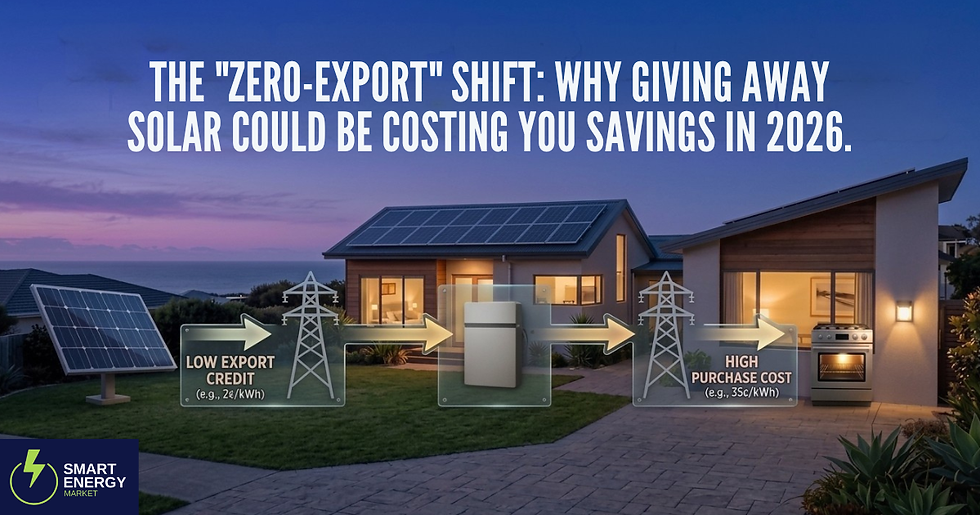
For many Australian households, the issue comes down to timing. Solar electricity exported during the day can earn much less than the electricity purchased from the grid that evening.
To get more value from your system, it helps to ask: How much of your own solar energy are you actually using?
Why Your Solar Credits May Feel Smaller
Feed-in tariffs pay you for electricity exported to the grid. These payments have fallen significantly since the early days of rooftop solar and are generally lower than retail electricity prices. Your actual rate depends on your location, retailer and plan. Australian Government Solar Consumer Guide
Consider a household receiving 2 cents per kWh for solar exports while paying 35 cents per kWh for evening electricity. These are illustrative rates, rather than national averages.
Exporting 10 kWh earns just 20 cents. Purchasing 10 kWh later costs $3.50.
That difference highlights the potential value of using more solar at home. However, it is not an automatic loss on every exported unit or a guaranteed battery saving. Storage efficiency and equipment costs also affect the outcome.
What Does “Zero Export” Actually Mean?
A zero-cent feed-in tariff means you receive no payment for the affected electricity exports.
A zero-export limit means your system cannot send electricity into the grid.
These are different situations. Turning off exports does not automatically improve savings. If excess electricity cannot be used or stored, your solar system may reduce its output. Where exports still earn a positive credit, exporting genuinely unused energy can remain worthwhile. Solar savings and export limits
The goal is to make better use of your solar energy, rather than simply aiming to export nothing.
How a Home Battery Can Help
A home battery stores surplus daytime solar for use later, helping reduce grid purchases when the sun goes down.
For households that use substantial electricity in the evening, this can make solar generation more useful. Instead of exporting most of your surplus, you can keep some available for cooking, lighting and other evening needs.
However, a low feed-in tariff alone does not guarantee that a battery will pay for itself. The financial benefit depends on the installed price, available solar surplus, electricity rates, storage losses and how frequently the battery is used. How batteries reduce electricity bills
A suitable battery should match your household’s consumption and solar generation across the year. Paying for extra capacity that rarely gets used can weaken the return on your investment.
The January 2027 Battery Rebate Change
If you are considering storage, the federal battery discount schedule is worth understanding.
The Clean Energy Regulator lists the following Small-scale Technology Certificate (STC) factors:
Installation period | Battery STC factor |
May–December 2026 | 6.8 |
January–June 2027 | 5.7 |
July–December 2027 | 5.2 |
These factors apply per eligible kilowatt-hour of usable battery capacity, with support tapering for larger systems:
First 14 kWh: 100% of the applicable factor.
Capacity above 14 kWh up to 28 kWh: 60%.
Capacity above 28 kWh up to 50 kWh: 15%.
The reduction from 1 January 2027 means fewer certificates for the same eligible battery. However, the final installation price also depends on hardware costs, installation requirements and certificate values. A smaller incentive does not automatically mean a higher total price. Clean Energy Regulator battery rules
Ask your installer to confirm the expected installation date and rebate assumptions in writing. Do not assume that signing a quote secures the earlier discount.
Three Ways to Get More Value From Your Solar
1. Move suitable appliance use into sunny hours
Schedule your dishwasher, washing machine or pool pump when your system has spare solar generation. Check your monitoring app to identify the best times, and stagger appliances to avoid drawing more power than your panels are producing.
2. Compare the whole electricity plan
Look beyond the advertised feed-in tariff. Compare daily supply charges, import rates, demand charges and export conditions.
A plan with a higher solar credit may still leave you with a larger annual bill. The best choice depends on how much electricity you import and export, and when. Understanding electricity plans
3. Size your battery using actual household data
Provide recent bills and interval usage data where available. Ask installers to explain the recommended capacity, estimated annual savings and total installed cost.
Consider how your needs might change, including future EV charging or electric appliances, without paying for unnecessary capacity today.
Make Your Solar Work Harder for Your Home
Smaller export credits are a reason to review how your household uses electricity.
Better appliance timing, a suitable energy plan and carefully sized battery storage can help you capture more value from your rooftop solar.
Smart Energy Market helps homeowners connect with trusted, vetted installers and explore solar, battery and rebate options suited to their needs.
Ready to make better use of your solar? Visit Smart Energy Market and request a quote for your home.


Comments